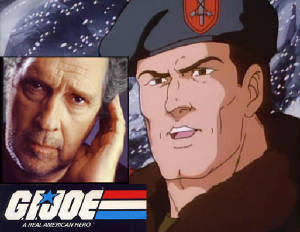
I heard you tell a story about the old GI Joe dolls and how somebody switched out the voice-boxes,
what was that about?
There was an organization, I have to look it up on the internet again, that I think in the late 80’s,
that when the first year the voice chips came out successfully in toys, and I don’t know if you pulled a string or
pressed a button, but this organization went into Toys ‘R Us and large department stores… apparently a couple
places across the country, and purchased over a hundred… two-hundred and fifty Barbie’s with voice chips and
Joe dolls, various characters, from the Joe team. And took them back to their dormitories and their science
labs at school and swapped the voice chips. [laughs] And then they re-packaged them, sort of the opposite of stealing
– having paid for them… brought them back in backpacks into the Toys ‘R Us and Macy’s – back
on the shelves. So little kids would get GI Joe’s and open them up on Christmas morning and the GI
Joe would giggle and say [in a young feminine voice] “I’m not
very good at math” [laughs] and Barbie would say [in a deep masculine voice]
“Alright Lady Jaye, Cobra is coming and we can’t bring up the laser threat weapon system!” [laughs]
They’re like toy terrorists.
I Googled it, not so many months ago, but I think I said something
like ‘toy terrorists’ or ‘GI Barbie voice swap’ and the story was still up in a bunch of newspapers.
The organization had a name and everything. [laughs]
Actually I wanted to
start off with a quick story about, I’m a big fan of GI Joe and years ago… more than twenty-five years ago…
I used to sit in the living room and record it with my little tape recorder and get my favorite voice-actors, which was
you as Flint. And I used to record your voice and then go back to my bedroom and pretend that I was some
sort of late night talk show host and I would interview you.
[laughs] That’s great. [laughs]
And
here I am, twenty-something years later… doing exactly what I did.
So you were only twenty-five years back then?
Exactly. [laughs]
[laughs] That’s great. Actually I did a volunteer thing
at a high-school here, and this little Vietnamese girl… seventeen or eighteen… I think she was a senior…
came up to me, and she had a very slight accent and she started naming all of these characters on GI Joe. And
I said “Were you like a production assistant on the show or something?” and she said “No, that’s how
I learned English.” She left Vietnam when she was like eight years old and sat and fell in love
with GI Joe for some reason and Transformers – and listened, I don’t know if she had a VCR and was able to play
things back, but she learned English that way. She knew all of the actor’s names. [laughs] It was
wild.
So did you do anything like that when you were a kid?
Of course, absolutely.
My first memory of television – this was way earlier in the 50’s when not all of Americans had televisions
– and people were buying them very very quickly, kind of like the internet in 1995… or something… where
a third of American homes had televisions. My father bought one and one afternoon after kindergarten
he literally showed me, he said “Alright, just twist this knob and just wait and wait and wait… and it comes
on and when you’re finished watching twist it the other way, wait for the click… and there you go, have a good
time.” So I was so excited, the next day I came home by myself after kindergarten… turned
on the TV and watched some kid show and the kid’s show host ended the segment… and then an announcer…
a voice-over guy came on and said the following words [in an announcer voice]
“This commercial message will be sixty seconds long.” Any why they had to announce that –
or why they felt they had to – or if it was a FCC requirement… TV was so young… I had no idea.
And on came an Oldsmobile from 1952, or whatever it was… I remember the visuals… a black and white
television commercial of a car with an American family with 2.5 children in it… rolling through it in the rolling
hills waiving at the camera. I sort of held my breath for sixty seconds, and so I thought this is the
first moment in my life in which [I knew] what a minute was. The duration of sixty seconds was absolutely
rock solid clear to me, and I ran to my mom and said “Mom, I know what a minute is!” She said, “What is
it”… “Sixty seconds”… “How’d you know that?” “A man on TV.”
So I was really very aware, and I was about five and a half… of TV voices. And so wandered
around, in the same period of time, with my father’s Gillette razor blade dispensers… fortunately no blades
were in there or I would have cut my finger. Which actually if you had it in your hand it’s probably
in a museum somewhere, it looks like a tiny radio devise of some sort – it has a piece of metal that sort of imitates
an antenna – and I used to wonder around at that age pretending that I was broadcasting. [in a broadcaster’s voice] “We’re walking outside now with our rubber
boots, it appears to be snowing, my mother has shut the door and told me to go play alone in the backyard. We
are heading towards the garage now, we don’t know who’s inside…” So, yeah…
I mean to answer your question… yeah, I did do that kind of stuff. I think every kid, in one way
or another, imitates… this is how you and I ended up in this weird area of interest. Through sort
of having it filter into our brains. And then some of us decide to imitate it and then go a little farther.
How did that step into the business actually work for you?
Well, my father was
in advertising, and he was an advertising exec… so he would bring me to work when I was ten, eleven, twelve…
he died when I was fourteen, but I said that I was going to try to get a job… it wouldn’t be easy, but maybe
they’ll give me a job over at the ad agency. And so I worked for an advertising company in Minneapolis,
which at the time was the biggest ad agency west of the Mississippi River… at fourteen and throughout high-school
off and on. When I was a senior in high-school I rode my bike downtown and went to work for the summer,
and large ad agencies, at the time anyway, had every conceivable facility… they had recording booths for announcers,
they recording rooms for small orchestras and singers to sing jingles for TV and radio commercials. They
had artists in their studios doing airbrush painting and pen and ink, and photographer’s dark rooms… full media
universe. And as an errand boy, you could stick your nose in every conceivable corner… and then
I snuck into the seminars that were intended for the account executives. I eventually got tossed out and
then I asked permission “No, please take pity on me, I’m just a dumb high-school student.”
I was a journalism major, I did not do well at school. And ended up doing theater later, and really
it took quite some time to get back to commercial media – at around age thirty, I took a sales job at a radio station
with a proviso that I could voice some of the spots. They were so hard up for somebody to work for so
little of money that they took me and I ended up spending more time in the studio just cutting spots and doing weird things,
and ultimately got a job in the day shift of this beautiful music station that played like horrible instrumental cover tunes
of Beatles songs… Rolling Stone songs… but it was a start. So that’s sort of the short
answer to your question.
Would you say that you had a lot of good support
when you started doing voice-over from other actors or other people that you knew?
The only support that I had, fortunately…
my dad when he died had a little bit of money… he wasn’t a millionaire, he was a business man… and was
not a rich guy, but I had enough money when I was about twenty-seven to start taking voice-over workshops. I
had a few thousand bucks in the bank, so when I came to Hollywood I got the good advise from a sales guy at a radio station
up in Northern California ‘you should take voice-over workshops, here’s the name of a guy’.
So I went and the guy had worked for Dick Clark and he’d been a big program director and he’d been sort
of a famous personality in St. Louis, but he had fallen on hard times and gotten into drugs… and so he would teach
the class going off into the bathroom and coming back started talking like this [with a nasally voice] with a certain nasal
stimulants. But he was a bright guy, and he loved the business… and he had interesting friends.
And in terms of support, that was really the only support that I had… was the fact that fortunately there
were a couple thousand dollars left in the bank and I was able to pay for voice-over workshops. After
that, it was really up to me – I knew no one in Hollywood – I knew no one in the business. And
so it was really a numbers game… getting an agent took quite some time. I did some hot things,
I little display ads out in a couple of magazines with some weird photograph of me – I noticed that in Variety and
the Hollywood Reporter… which are two kind of tacky, not so brilliantly written magazines in Hollywood, but they
are heavily subscribed to online, especially these days, by film and television executives, distribution people and anybody
associated with the business of film and television. And maybe a subscriber base of about eighty-thousand
people – it’s like a small town newspaper, but these are the decision makers who create television and film.
And I noticed that in those magazines, actors would advertise with their pretty little headshot with their nice white
teeth and their hair well done. I said that “these things look so boring”, that I had a girlfriend’s
brother, who was taking a photo class in some school, lie me down on the floor in a pair of boots and jeans and a leather
jacket with my hand on my chin… it says “Looks relaxed, doesn’t he? Well, when this guy stands up to a
microphone he works and works right. Listen for him Friday February 17th on ABC-TV’s
‘Heroes of Rock ‘n Roll’.” I just lucked out and got two lines on an ABC special
about rock ‘n roll and it wasn’t a big deal at all, but I made it look like a big deal and actually got calls
from agents. I think I learned early the magic of smoke and mirrors, which is the magic of advertising.
Is it true, or is it untrue? No, it’s true… but this is the most important thing in
the world. The marketing of GI Joe was actually brilliant, it made it seem like an absolute cultural
phenomenon… and thus it became a cultural phenomenon in terms of numbers of people watching.
 Yeah, because if they didn’t make toys for each character – who knows how many kids wouldn’t have gotten
involved in the show in the first place.
Yeah, because if they didn’t make toys for each character – who knows how many kids wouldn’t have gotten
involved in the show in the first place.
That was the brilliance of it, I think. That you can go on eBay and buy the
original GI Joe from the 50’s… early 60’s… who was a large Barbie with five day growth of beard
and a cigar sticking out… and you could take his helmet off and jacket off… you could change his boots…
you could buy little accessories like that formulaic gun… probably different guns… a 45 automatic and one
rifle. But then years… you know there was a comic book, GI Joe that I think lasted for years…
I know GI Joe was around during the Korean war, I don’t know about World War II. And then GI Joe
sort of fell out of radar for what ever reason, maybe because of the 60’s and the Vietnam War… people weren’t
interested in this old fashioned character who was not funny, he was just this kind [using a tough voice] old fashioned
hero warrior. And some brilliant soul at Sunbow Productions and Hasbro said… probably Hasbro…
said “Gee, why don’t we create five or six characters?” And then they did the first mini-series
in about ’82. And that did so well, they syndicated it… they sold it to individual stations.
And it did so well that they said “Well, let’s go into full production with the show.”
So the mini-series, which you can get on DVD, I think they did five episodes… they may have done another five…
and then they created twenty-six episodes a year for a couple of years. And the number of characters multiplied,
which as far as creative was concerned… made it a more interesting show. And there were black characters,
Asian characters… more women… there was a lot of variety. Characters with weird names…
and so on. We sat down with a bunch of thirteen year old boys and said, “If you guys
had the money – somebody just handed you the cash – and you were told to buy only one of each Joe action figure…
from vehicles to characters. How much do you think it would cost?” And it ranged
from thirteen to eighteen to twenty-one to twenty-two hundred dollars. And we blew it because the script girl in the
beginning… on the very first episode… was passing the scripts out to about ten of us, said “Oh, the
producers say that you should probably buy Hasbro stock.” We said, “Why should we buy Hasbro
stock with a TV show?” She said, “Because we’re going to sell the toys.” “Oh,
big deal.” Well, [laughs] if not rich… we would have made some money. Nobody
paid any attention except the Hasbro executives.
Do you have any good
stories you can tell me about either your time filming… the recording sessions… or any time while you were
doing GI Joe?
Well, the most memorable day was when a gentleman named Chuck McCann [“Leatherneck”
on GI Joe] came in to play a character, and he was already in his early sixties [using a deep voice] big Irishman
with blonde hair. And I had known him only from having made a motion picture that he wrote, produced,
edited with Rodney Dangerfield as a head usher in a movie theater called The Projectionist. Chuck McCann
played the character, the projectionist. It was kind of an odd film, much like Robert Downey’s fathers
films… Robert Downey Sr. was a filmmaker who made motion pictures in the 60’s and 70’s, not that many
people saw them, but they are sort of odd cult movies. I was talking with someone about puppetry, and
Chuck McCann looked at me with a very serious look on his face and said [with a deep voice] “Puppetry, are you a puppeteer?”
I said, “Well, I mess around with…” He says, “I created ‘Rootie Kazootie’
and ‘Fearless Fosdick’.” I said, “Wait a minute, you created ‘Fearless Fosdick’…
the television show?” And in the 50’s, for thirteen weeks only… the Fall from September
through… up to Christmas… NBC Television Network aired thirteen weekly episodes of “Fearless Fosdick”,
which was a live marionette show about this odd detective who worked for Dick Tracy, he was a minor character in the Dick
Tracy cartoon strip who had a girlfriend named Prudence Pimpleton with huge pimples on her face. And every
time he would get shot by a bad guy he would open up his shirt and you could see holes – huge swiss cheese holes in
his chest. And he was always being shot by bad guys and chasing bad guys through crappy town and buildings,
and they built these sets… kind of like film noire… like TV shows in the 50’s… you know, “Naked
Gun” and this and that. It was the most amazing thing I have ever seen, again I was five and a
half years old and I watched this… I was hypnotized by it. By these weird herky-jerky marionette’s
that looked like dolls on Darvon or something. With strings that you could see… fully dressed with
guns in their pockets… [in a gangster voice] “Alright you lousy creep… BANG BANG BANG.”
With smoke coming out of the little prop gun – it was the wildest most incredible thing I have ever seen, and
here I am rocketing back in time. And then that Christmas, after Christmas when I went back to school
in January as a Kindergartener… the show was no longer on, and I cried and I freaked out… and my dad came
home that night and I said, “What happened?” And he said, “Well, there’s no accounting
for taste in television and quality won’t necessarily out… quality doesn’t necessarily win.
Sorry. Probably couldn’t hold its advertisers.” And so here I am
at a GI Joe session in 1985 staring at this man, and I said, “You created that show?” He said,
“I wrote it, I directed it, I built all of the marionettes, I had a few assistants.” And I
said, “What ever happened to the marionettes?” And he said, “I have them at my house…
setup… I have this whole set in the basement with lights and everything.” And I said, “Is
there any chance that you would allow me to come over and see them?” He said, “Yeah, sure…
just call me up.” He was in the show, I can’t remember his character’s name, he was
a recurring character for a few weeks and then that was it… and I called him and I called him and I called him…
and he would never return the call. So I said, “Well, I must have seemed like a pain in the butt
or something.” I told a couple of friends this story, a man named Lorenzo Music who was the voice
of Garfield the cat and years ago he was also the voice of [using a slow voice] Carlton your doorman and Rhoda… the
same thing happened to him. Chuck said, “Come on over…” and Lorenzo called him and
called him and called him… and apparently he was a very private guy who went public and brag about his puppets, but
when it came to answering the phone he never did. It doesn’t have a lot to do with GI Joe, but it’s
sort of the lore of children's television.
 But I think, on this more of a serious level… Wally Burr, who is still alive… he was the youngest tank commander
in World War II… Captain Wally Burr was our director and he was directing in a very new way. Most
cartoons in that time were directed with [using a high pitch voice] “Everybody have a cartoon silly voice –
you are really big, you are falling in a hole, oopsy.” And he directed for psychological and emotional
reality, GI Joe was really the first show that was directed that way. So those of us who were voice-over
people and actors… that was fine. Cartoon people had to get used to it, [in a high pitch voice]
“We’re doing silly voices.” He said, “No, no, no… this is for real, you’re
a real guy. Somebody is firing weapons at you and you are lying in the jungle… worms and dirt are
in your face.” So that made it really fun, but what was odd about it was that you couldn’t
overlap dialogue like they do in television or film where people are talking at the same time… you had to be as real
and naturalistic as possible and yet pause for the other actor to speak and pause after the other actor has spoken their
dialogue. And sometimes do it alone, sometimes you record alone… usually they wanted everybody there.
But there would be ten people lined up at their microphones all doing their very weird sort of voodoo… waving
their arms around. There was one guy who looked like he was always cleaning his aura with his fingers,
and that would somehow allow him to speak. So the memories sort of blur because we did over one-hundred
sessions, but they were some of the most fun recording sessions I’ve ever done. Mainly because
there were a lot of people and it was acting rather than announcing – it was new and this thing was on TV – it
was very exciting.
But I think, on this more of a serious level… Wally Burr, who is still alive… he was the youngest tank commander
in World War II… Captain Wally Burr was our director and he was directing in a very new way. Most
cartoons in that time were directed with [using a high pitch voice] “Everybody have a cartoon silly voice –
you are really big, you are falling in a hole, oopsy.” And he directed for psychological and emotional
reality, GI Joe was really the first show that was directed that way. So those of us who were voice-over
people and actors… that was fine. Cartoon people had to get used to it, [in a high pitch voice]
“We’re doing silly voices.” He said, “No, no, no… this is for real, you’re
a real guy. Somebody is firing weapons at you and you are lying in the jungle… worms and dirt are
in your face.” So that made it really fun, but what was odd about it was that you couldn’t
overlap dialogue like they do in television or film where people are talking at the same time… you had to be as real
and naturalistic as possible and yet pause for the other actor to speak and pause after the other actor has spoken their
dialogue. And sometimes do it alone, sometimes you record alone… usually they wanted everybody there.
But there would be ten people lined up at their microphones all doing their very weird sort of voodoo… waving
their arms around. There was one guy who looked like he was always cleaning his aura with his fingers,
and that would somehow allow him to speak. So the memories sort of blur because we did over one-hundred
sessions, but they were some of the most fun recording sessions I’ve ever done. Mainly because
there were a lot of people and it was acting rather than announcing – it was new and this thing was on TV – it
was very exciting.
And then recently you had a chance to re-live the character with
“Family Guy” and “Robot Chicken”, what was that like?
Well, Seth MacFarlane, who I don’t know, called
my agent just on a whim… and for the premiere episode of the fourth season when it was going back onto FOX…
it had been removed from TV and they said ‘wait a minute, we’re going to bring it back in the fall’ –
and he happened to call a woman who was my agent and said, “Is the guy who did Flint still alive?”
And she said, “Uh, yeah… we represent him.” Because he was about eight, nine,
or ten years old and GI Joe was his favorite show and he thought Flint was cool. So he wrote a part for
Flint and usually, especially with cartoons and games, they want you in the recording studio. They have
a way of recording it that the director is doing some sort of intense directing ‘ok, take two louder – take three
faster – take four a little more intense – take five a little angrier’, and the recording session for
the premiere episode going back on FOX I couldn’t show – I couldn’t – there was no way I could do
it. And he said, “Well, can you do it from your basement?” And he was on
the phone with me and he was telling me his stories about watching GI Joe and [laughs] so he created this episode where I
didn’t have a major role in the episode – just a minor part – catching kids drinking in the bathroom,
the vice-principal catches them at a school dance drunk and Flint comes out of the bathroom stall saying, “That’s
right, kids over three-hundred and seventy-five thousand people died of alcohol related diseases just last year.
And knowing is half the battle.” Then Seth Green, who also is part of the show, said, “Well,
I want him for my show. I watched GI Joe too.” I’m on a couple of episodes
of “Robot Chicken” and my biggest regret, one summer I was heading off for vacation – and I booked the
tickets and got an invitation to the Playboy Mansion… Seth Green was throwing the party for the release of season
two of “Robot Chicken” on DVD. Oh man.
I read on IMDB.com that
you were credited to writing one episode of “Silverhawks”, is that true?
No. It’s weird, IMDB is
strange – and they don’t really let you – they don’t let you – the editing is very, very
weird… you can add stuff to your resume if you want – if you’ve got your own password and everything…
they don’t let you edit or add. It’s odd, it’s like… “Well, we have to confirm
with the studio.” So they have me writer of one thing… and I get Google notices about having
written this series of business journals that I narrated but never wrote. I think that, you know, what
happens – I know of a actress when she was a little girl got hired to be on the set of a Texaco commercial, and was
told ‘Well, you know, the client wants the little boy… we’re really sorry but…’
But somebody put her on the cast list, she didn’t appear in the commercial, somebody put her in the cast list…
either because they were mean to the little girl and kicked her off the set or because she made a mistake… and she
ended up getting fifty-thousand dollars in residuals. And the legality of it is, the payer… in
this case Texaco and it’s ad agency… had exactly one year, three-hundred and sixty-five days to get the money
back, and they didn’t so they ended up paying for a couple of years of her college. Having gotten
a false credit like I got as writing one of the episodes.
 Do you still do the competitive storytelling?
Oh, yeah… you bet. In fact, it’s kind of growing.
Started in New York about fourteen years ago with a writer – who is a thriller writer, a fairly successful
mid-list thriller novelist named George Dawes Green… who had a party in his loft in lower Manhattan with his friends…
you know, writers and editors and a few actors probably. You can come to his party but you have to bring
a five minute story – no notes… you’ve got to tell it, and here’s the theme… you know, “Broken
Hearts” or “Ride Into the Sunset”… or whatever the theme was. And they all did
and they brought food and drink… and everybody sat there for two or three hours… one person telling at a time…
they judged it, and it was so fun that everyone said ‘let’s do it again – let’s do it again’,
and Green said ‘well, I don’t want to do it in my apartment again. That was hard work.’
And so they got a coffee house or a bar that wasn’t busy from seven-thirty to nine-thirty on a Tuesday night –
and it’s grown so there are five venues in New York, most of them night clubs or rock ‘n roll clubs or coffee
houses. There are three in LA, one in Chicago, one in Detroit, there’s a radio show called The
Moth Radio Hour… it’s on sixty-five NPR radio stations. The Moth Podcast is the number ten
podcast on iTunes – people apparently love to listen to personal stories. It’s
storytelling, and not old fashioned stories… you have veterans talking about getting shot at… there was a
hooker who got up and told her story about broken hearted love. Unbelievable stuff, and it’s three
times a month in LA at three different night clubs. You go in and sign up and have your story prepared
in your head – and if you’re called you get up and you tell it and you’re judged… and if you win
the highest score of the evening you go on to the semi-annual competition in a big rock ‘n roll club called Echoplex
in Central LA. And if you win that, then you go to New York for the Moth Ball and perform there for all
of the stars. [laughs]
Now, how far have you gotten in the competition?
I’ve been in four grand slams – I’ve got my fifth one coming up in February twenty-first in LA…
and have not won a grand slam. I have won seven slams where… about a hundred and fifty…
two-hundred people crowd in the club and about twenty-five people with their name in a hat called… and they all tell
their story one at a time. You know, instead of watching a rock band or watching television… they’re
watching somebody tell sometimes an embarrassing… sometimes hysterical… sometimes tragic… usually fairly
fascinating story of the person’s life, a true story. And you get up and hopefully
get a few laughs and tell a decent story… its fun.
Yeah, I’ve never
heard of it… it sounds like a version of stand-up comedy.
You know, it’s funny… the New York Times
did an article about it years ago and said The Moth, which is the organization that sponsors these story telling slams,
The Moth is the new stand-up. And what I think they really meant is – the stand-up scene has kind
of deteriorated a little bit in that it’s not… I mean… I could be wrong, but a lot of stand-ups say
this… that unless you do pee-pee poo-poo jokes constantly, you know, you’re really not going to get a laugh.
The crowds have gotten really kind of raunchy… and so a lot of stand-ups do The Moth because they’d rather
tell stories and they can be funny, but not have to do a joke every five minutes. And a lot of…
everybody from movie writers to office managers to rock veterans are showing up, but it’s not like stand-up in that
you aren’t writing jokes… stand-up there’s a joke every twenty-five seconds. I actually, there was one
contest that I almost won… except I was beat out by a guy with this tragic tragic violent story about his family.
And we were in the grand-slam together and I said, “What do you do for a living?” He
said, “I’m a stand-up comic.” “But your story was a killer, it was so sad.”
And he said, “Well, it ain’t stand-up comedy… it’s story-telling.”
What do you have coming up next, what are you working on?
Well, I’m on the
Hyundai campaign with the fabulous Jeff Bridges, that’s been going on for a while… where he does the body of
the spot and then I do the tags which is nice. And it’s funny because on the Oscars a year ago
in February of 2010, he was up for an Oscar and he was all over these Hyundai spots – one of the rules of the Motion
Picture Arts and Science is that Oscar nominees are not allowed to appear on any commercial messages within twenty-four
hours of the Oscars. So the ad agency that handled the Hyundai account had to pull the pots that Jeff
Bridges’ voice was on for twenty-four hours, and put me on some… put other guys on others… then put
them back on the air the day after he won his Oscar.
And what else? Taco Bell spots
[impersonates the Taco Bell commercial], that’s been playing at all of the football games, my fantasy is that it’ll
play on the Super Bowl and I’ll make a couple of bucks. What else is coming up? On
the ID channel, which is Discovery Investigation… there’s a show called “I almost Got Away With It”,
which is ongoing. I narrate that, and it’s really interesting bazaar stories… they’re
getting harder to get because they have to find somebody in jail or somebody who has been paroled, but these people are
generally not going to be paroled… pretty serious crimes. They have to be able to get the person,
get the prison to agree to allow the crew to come in… hopefully get some family members to agree to be interviewed,
and get the story straight so it’s actually what happened… and then they film some re-creations of the crimes
and the running away from the law. So that’s ongoing, that’s kind of fun.
I’m appearing
at Flappers Comedy Club in Burbank, California on Sunday January 30th. Echoplex rock ‘n roll club on Monday night February 21st. As far as voice-overs and games and
cartoons; I’m auditioning for stuff. People say ‘You don’t audition anymore’…
of course I do – there are so many new people writing and working for the game companies… and some of them
have no idea who I am. If somebody were to sit them down for a half an hour and say ‘Well, he’s
the guy who….’ ‘Oh, ok….’
And now days it seems like everything
is going to some kind of major celebrity.
Well, yes. Celebrities love… especially
features like Megamind… I did the trailer campaign for Megamind. Which was really nice doing all
of those TV spots – it was fun… with Will Ferrell and Tina Fey… etcetera, etcetera, etcetera.
Brad Pitt for goodness sake. I think, cynically a lot of cartoon writers and feature films said
that here are stars with divorces and kids they never see… that they get to finally do something their kid is going
to be able to see and think is cool. And they can bring them to the studio. But its
fun, I mean its fun… it’s challenging. Animated work is fun, and for movie stars who are
used to being on a set for weeks if not months go into the studio for a few hours on a couple of occasions and get paid
really decent money… and then be able to have this Thanksgiving with grandma and grandpa and your estranged children…
‘dad that was really cool, I love you after all’… so, and obviously it brings in the bucks for the studios.
[using an announcing voice] ‘3-D and with the voice of Brad Pitt’. So whether that actually
works, whether it brings in an audience… I don’t know. Big names do, but they don’t
get to see their faces… just hear their voices and often times they are playing a character that’s unrecognizable.
Almost like Justin Timberlake as Boo-Boo Bear in Yogi Bear.
Exactly. But he did a great job
in The Social Network.
So, it’s true. And in terms of on-going series – well, there are
fewer and fewer on-going cartoon series compared to what was going on in the 80’s… there was so much more going
on… there are more and more games. But these games, the big games… Grand Theft Auto IV I
think was an eighty-five million dollar game, which is like a major major motion picture. So they do
have some celebrities for their name, but there’s so much work to be done… it’s a peculiar craft…
voice-over… they tend to find the people who do it on a daily basis. They can get it done and
are more efficient with their time and less confused and less emotional about it and less erratic, whereas actors who don’t
do a lot of voice-overs may have beautiful voices and interesting personalities, but tend to not want to go in day after
day or week after week to do the same thing. So that’s why the cartoons that are on the daily or
weekly basis… for instance… ‘The Simpsons’ those people have become celebrities, but they certainly
weren’t celebrities… they were just journeymen voice-over people. And I think that’s
true with ‘Family Guy’ – they were just a couple of people writing the show and regular journeymen voice-over
people. No big names, now they’ve become names because of the show.